RESP Withdrawal Rules: EAP vs. PSE Explained
Commentary • Education
Date posted
Aug 17, 2026
RESP Withdrawal Rules: EAP vs. PSE Withdrawals Explained
If you're getting ready to withdraw funds from a Registered Education Savings Plan (RESP), you'll come across two terms that sound similar but work very differently: EAP and PSE withdrawals. Understanding the distinction matters because it affects how much tax is paid, and by whom.
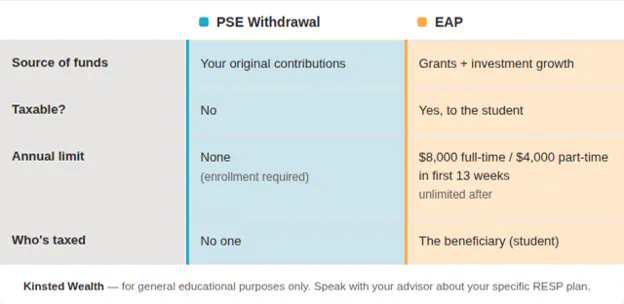
Quick answer: A PSE withdrawal returns your original RESP contributions tax-free, with no CRA dollar limit. An EAP releases the grants and investment growth instead, which is taxed to the student — up to $8,000 in the first 13 weeks of full-time study, or $4,000 for part-time, then uncapped. The right mix of the two can reduce how much of the plan's value is lost to tax.
What is a PSE withdrawal?
A Post-Secondary Education (PSE) withdrawal is simply a return of the contributions you made to the RESP as the subscriber. Because those contributions were made with after-tax dollars, PSE withdrawals come out completely tax-free, no matter who receives them. [1,2] There's no CRA-imposed dollar limit on how much can be withdrawn this way, if the beneficiary is enrolled in a qualifying post-secondary program. [1] Many RESP promoters do, however, require proof of enrollment before releasing these funds. [2]
What is an EAP?
An Educational Assistance Payment (EAP) is made up of everything in the RESP that isn't your original contributions: government grants such as the Canada Education Savings Grant (CESG) and Canada Learning Bond, provincial grants, and the investment growth the plan has earned over the years. [1,4] Because none of this money has been taxed yet, EAPs are taxable, but the tax is paid by the student, not the subscriber. [1] Since most students have little or no other income, the tax owing is often minimal or zero.
EAP withdrawal limits
EAPs also come with withdrawal limits tied to the beneficiary's enrollment status:
- Full-time studies: up to $8,000 during the first 13 consecutive weeks of enrollment. After that initial period, there's no cap as long as the student remains enrolled. [1,4]
- Part-time studies: up to $4,000 per 13-week enrollment period. [1,4]
These limits reset if 12 months pass without the student being enrolled for at least 13 consecutive weeks. The funds are meant to cover reasonable education-related costs, including tuition, books, housing, food, and transportation. [5]
Why the distinction matters
Because PSE withdrawals are tax-free and EAPs are taxed in the student's hands, the order and mix of withdrawals can make a real difference in how much of the RESP's value ends up being lost to tax or triggering a grant repayment if the beneficiary doesn't end up pursuing eligible studies. [3] Withdrawing strategically, drawing more from EAP room while the student has little other income, and reserving contribution room for later years, can help make the most of the plan.
RESP Withdrawals: PSE vs. EAP
How the two withdrawal types differ, at a glance
The takeaway
There's no single "right" way to split withdrawals between PSE and EAP; it depends on the student's other income, the plan's balance, and how many years of studies are ahead. If you're planning a RESP withdrawal this year, it's worth a short conversation with your advisor to make sure you're sequencing things in a way that keeps more of the plan's value working for the student's education, rather than going to tax.
Frequently asked questions about RESP withdrawals
What's the main difference between a PSE withdrawal and an EAP?
A PSE withdrawal returns the contributions you made to the RESP and is always tax-free. An EAP releases the grants and investment growth in the plan instead, and is taxed to the student rather than the subscriber.
Is a PSE withdrawal taxable?
No. Because contributions are made with after-tax dollars, PSE withdrawals come out completely tax-free, regardless of who receives them.
How much EAP can I withdraw in the first year of school?
Up to $8,000 in the first 13 consecutive weeks of full-time study, or $4,000 per 13-week period for part-time study. After that initial period, there's no cap as long as the student stays enrolled.
Who pays tax on an EAP, the parent or the student?
The student. Because most students have little or no other income, the tax owing on an EAP is often minimal or zero.
Does it matter which withdrawal type I take first?
Yes. Since PSE withdrawals are tax-free and EAPs are taxed to the student, the order and mix you choose affects how much of the plan's value goes to tax, and can matter for grant repayment if the beneficiary doesn't end up pursuing eligible studies. Speak with your Kinsted Wealth advisor about the right sequencing for your plan.
Disclosure
This article is for general educational purposes and isn't a substitute for personalized tax or financial advice. Withdrawal rules can vary by RESP provider and are subject to change; speak with your Kinsted Wealth advisor about your specific plan.
Sources
[1] Employment and Social Development Canada. "Pay for Education Using the Registered Education Savings Plans and Related Benefits." Canada.ca. Accessed August 11, 2026.
[2] Canada Revenue Agency. Registered Education Savings Plans (RESPs). Guide RC4092. Canada.ca. Accessed August 11, 2026.
[3] Employment and Social Development Canada. "Managing the Registered Education Savings Plan, Taxes and Transfers." Canada.ca. Accessed August 11, 2026.
[4] Employment and Social Development Canada. "InfoCapsule 13: Educational Assistance Payments." Canada.ca. Accessed August 11, 2026.
[5] Canada Revenue Agency. "Registered Education Savings Plan (RESP) Bulletin No. 1R3." Canada.ca. Accessed August 11, 2026.
Regards,
Kinsted Wealth